Declaration of conformity
PPWR Declaration of Conformity: What Must Be in Place Now?
The EU Packaging and Packaging Waste Regulation has applied directly across the EU since 12 August 2026. For most businesses, that raises one immediate question:
What documentation must actually be in place now?
The short answer: if you place packaging on the EU market, you need an EU declaration of conformity following the Annex VIII model, the technical documentation behind it, and a clear view of the country labelling rules that still apply in the markets where you sell.
Manufacturers keep the declaration and technical file for five years for single use packaging and ten years for reusable packaging. Importers must keep a copy of the declaration and ensure the technical documentation can be made available to market surveillance authorities.
This is where many businesses are still exposed: packaging data spread across suppliers, emails and spreadsheets, with no single dossier pulling the legal references, market rules and evidence together.
What is PPWR?
The Packaging and Packaging Waste Regulation, Regulation (EU) 2025/40, replaces the old Packaging and Packaging Waste Directive with a single regulation applying directly in every EU country.
It covers packaging design, labelling, substances, recyclability, empty space and documentation. It entered into force on 11 February 2025 and has generally applied since 12 August 2026, with specific obligations phased in on later dates. There is no national transposition to wait for: the obligations land on businesses directly.
What must be in place now?
1. The EU declaration of conformity
Under Article 39, the manufacturer draws up a written EU declaration of conformity following the model in Annex VIII. The declaration confirms that the requirements of Articles 5 to 12 have been demonstrated.
The responsible party is not always the factory that physically made the packaging. In practice, responsibility often follows the business placing the packaged product on the EU market, the importer, or the brand on the packaging. That is why packaging, legal, procurement and artwork teams need the same evidence base.
2. The technical documentation
The declaration is the front page. Behind it sits the technical file.
That file may need to include component and material details, dimensions and empty space inputs, supplier declarations, testing references, country labelling decisions and deposit scheme screening where relevant.
This is the part many teams underestimate. The technical documentation is what makes the declaration defensible.
3. Retention duties
Under Article 15(3), manufacturers keep the technical documentation and the declaration for five years for single use packaging and ten years for reusable packaging, from placement on the market.
Under Article 18(7), importers keep a copy of the declaration and must be able to make the technical documentation available to market surveillance authorities.
This is not just document creation. It is document control.
What has the Commission clarified?
The European Commission has published Commission Notice C(2026) 3702 final, 5 June 2026, and a separate official FAQ, published 3 August 2026, closing many interpretation questions from 2025.
Three points stand out for packaging teams.
1. Who counts as the manufacturer
The guidance clarifies the roles of manufacturer, producer, importer and distributor. This matters because the company responsible for the declaration is not always the company that physically made the packaging.
For brand owners and importers, that distinction is critical.
2. The 5 percent plastic part threshold
The Commission FAQ addresses a threshold for small plastic parts. Plastic parts representing less than 5 percent of the total weight of the whole packaging unit sit outside the recycled content obligations in Article 7.
That matters for labels, closures, small plastic fittings and mixed material formats where a small plastic element may change the analysis.
The important practical point is evidence. If a business relies on the threshold, it needs material and weight data that can support the position.
3. PFAS limits for food contact packaging
Since 12 August 2026, food contact packaging must not be placed on the EU market if PFAS concentrations meet or exceed the limits in Article 5(5). Packaging placed on the market on or after that date must meet the PFAS limits.
For packaging teams, this turns PFAS from a formula question into an evidence question. Supplier declarations, test information and technical file records matter.
What still depends on the country where you sell?
A lot.
Harmonised EU labelling arrives later. Until then, national packaging labelling and marking rules still matter.
For example:
- France still has Triman and Info-Tri requirements.
- Italy still has environmental labelling and disposal wording.
- Spain has national packaging labelling requirements.
- Deposit return scheme rules can apply to covered beverage containers in relevant markets.
A useful dossier reflects both layers: the EU regulation and the markets where the product actually sells.
What does PPWR Copilot cover today?
PPWR Copilot turns scattered packaging information into a structured dossier.
Today it supports:
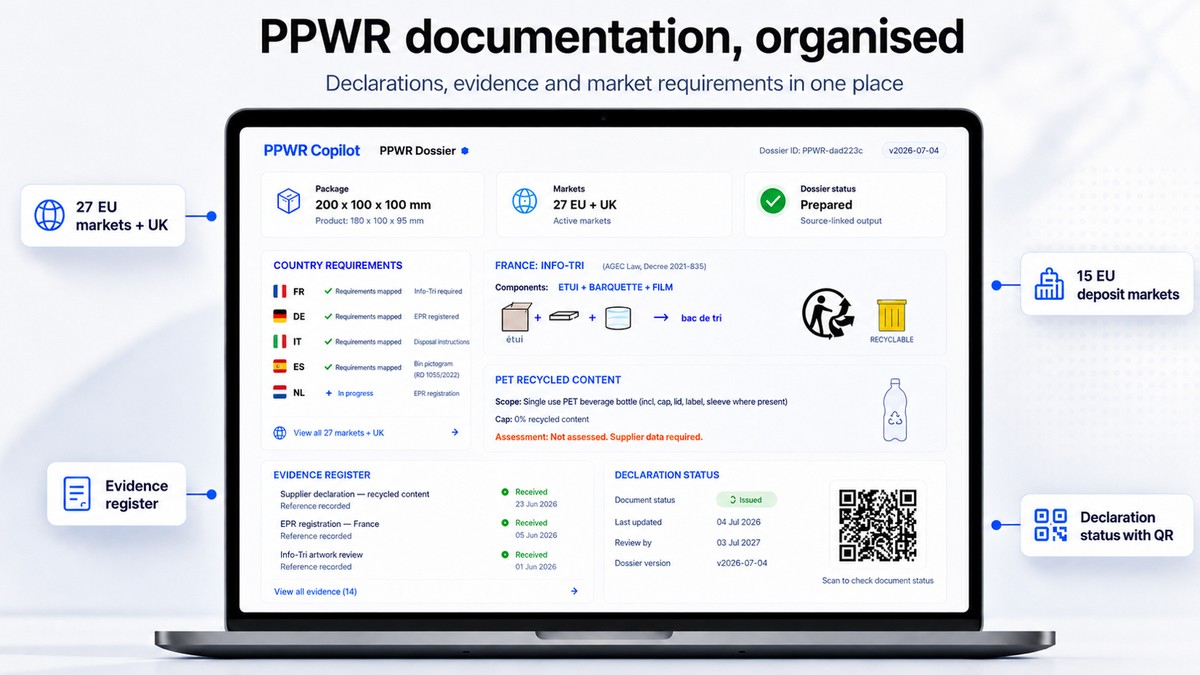
- Country specific legal references across all 27 EU markets and the UK.
- Deposit return scheme screening across 17 EU deposit markets.
- Evidence register records per dossier for the technical file.
- PET bottle recycled content tracking.
- Declaration of conformity workflows.
- Declaration status pages with QR.
- Public regulatory change log and dataset version tracking.
Every dossier records the regulatory dataset version it was generated with, so teams can see when an output may need review.
See the output before creating an account: view the sample PPWR dossier.
Importers can start here: PPWR for importers.
What should businesses do now?
- Map your packaging formats. Identify the packaging types you place on the EU market. Do not start with SKUs alone. Start with packaging formats, components and markets.
- Identify your selling markets. The country layer still matters. The same packaging may need different review points in France, Italy, Spain or a deposit market.
- Gather the evidence base. Pull together supplier information, material codes, component weights, declarations, test reports and recycled content data where relevant.
- Prepare the declaration workflow. Decide who drafts, reviews and signs the declaration of conformity. Make sure the technical documentation can support it.
- Use a dossier structure that can be updated. PPWR rules, national practice and supporting evidence will continue to move. A one off PDF is weaker than a dossier that records its dataset version and can be brought current.
Get your documentation in order now
PPWR Copilot turns scattered packaging information into a structured dossier covering all 27 EU markets plus the UK.
Importers can start here: PPWR for importers
Frequently asked questions
Does PPWR apply if I only sell online?
Yes. E-commerce and marketplace sellers placing packaged products on the EU market are in scope, including transport packaging around shipments.
Our manufacturer is outside the EU. Whose job is the declaration?
The declaration is drawn up by the manufacturer as PPWR defines it, which in practice may be the importer or brand owner. Importers must in any case keep a copy of the declaration and ensure the technical documentation can be made available.
Is the UK covered by PPWR?
No. The UK has its own packaging EPR regime. A dossier for products sold on both sides needs both the EU layer and the UK layer.
What happens when the rules change after I generate my documents?
Rules move. A dossier should record what it was generated against and be brought current when the rules do. PPWR Copilot records the regulatory dataset version for each dossier and maintains a public change log.
Does PPWR Copilot replace legal advice?
No. PPWR Copilot prepares structured packaging documentation and source linked review outputs. It does not replace legal advice, final artwork approval or producer responsibility.
Final thought
The businesses in the strongest position for PPWR are not the ones who rushed in August 2026.
They are the ones with their packaging formats mapped, their evidence organised, and their declaration workflow in steady use now that the Regulation applies.
The declaration of conformity matters. The technical documentation behind it matters just as much. And if you sell across multiple markets, the country layer matters too.
That is the gap PPWR Copilot is built to close.
Guidance only, not legal advice. Requirements vary by product, packaging type and country. The producer remains responsible for final decisions.